
 Contact Us



AUTHORS


For many practitioners, the journey with evidence starts with what is measurable and visible —
metrics, reports, dashboards, things that signal stability and control. Over time the questions
shift. Not just what happened, but why and how. Not just whether something worked, but for
whom, in what context, and what made it work or not work.
One person’s perspective alone does not move a system. Evidence becomes useful when it
contributes to a shared understanding — when it feeds into something larger than any single
report.
“While evidence is often initially viewed through the lens of dashboards and matrices that signal stability, it truly becomes a catalyst when it is understood not as a static output, but as a collective movement.”
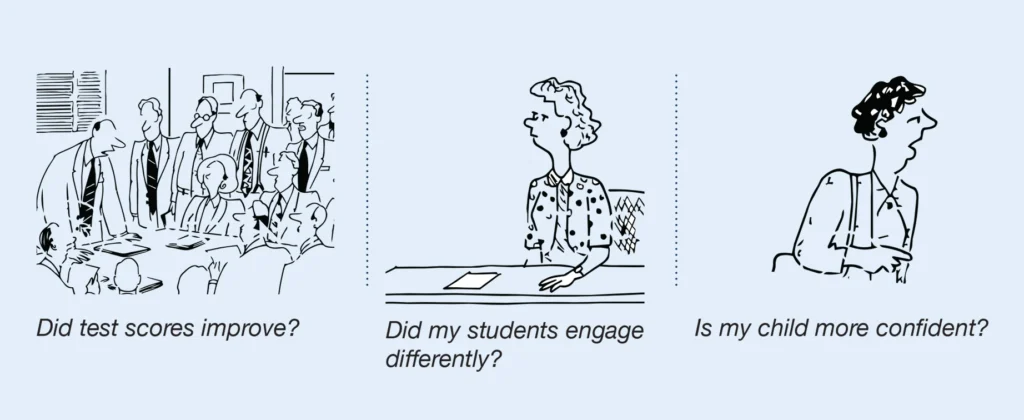
These are all valid questions about the same programme. Evidence that answers one may not answer the others. The work is finding how these perspectives connect — and that requires asking, early: evidence for whom, for what purpose, at what moment?
One of the most persistent difficulties in evidence practice is knowing when you have enough to move forward. Too much rigour seems paralysing. Too little and decisions feel arbitrary. The answer is a practical confidence in what you know, combined with honesty about what you don’t. Rigour is about being able to stand by what you know and staying honest about what you are still learning. An organisation that cannot hold that tension is not ready to act on evidence, regardless of how much data it has collected. Making yourself ready to act on evidence is a prerequisite to making evidence more agile.
Many organisations sit on large volumes of data without a clear sense of how to leverage them. Reports get written, shared, and almost certainly never read. Evidence gets produced, technically complete, and then handed over. It fulfills a requirement. It does not shape a decision. The measure of evidence is not whether the report was written. It is whether it changed something.
It is vital to recognize that the challenge is often not an abundance of knowledge, but the systemic suppression of it. By shifting away from self-fulfilling reports, systems can actively unlock the insights and knowledge that already exist within them.
Reports become self-fulfilling when they document activity without testing whether that activity is leading to positive outcomes. Evidence that serves its purpose helps organisations avoid investing in programs that have no effect or cause harm, and guides progress toward outcomes that matter, whether that means improved learning, changed teacher practice, or stronger
community engagement.
This becomes harder as programmes grow. A well-designed evaluation can show that something works in ten schools. But then the questions multiply: Does it work the same way in five hundred schools? Is there political demand at the state or national level? Does it fit what communities in different contexts actually need?
What a district administrator needs from evidence is different from what a classroom teacher needs. What a funder needs is different from what a community organisation needs. As scale increases, these differences sharpen. Evidence that worked at one level — a pilot, a cluster of schools — does not automatically translate to another.
One way to address this is to embed evidence gathering into how education systems already operate — into school reviews, teacher support visits, routine data collection — rather than treating it as an external exercise. If evidence becomes part of ongoing operations, feedback loops can become continuous rather than episodic. This does not eliminate the difficulty of scaling, but it changes the relationship between evidence and action.
Closing the loop on evidence only means something if it closes for the child whose learning was supposed to improve, or the teacher whose practice was supposed to change. If the evidence is not actually helping the community it concerns; regardless of how complete the reporting looks, the loop is not closed.
This is about agency. Whose questions are being asked? Whose definition of success is being used? The problem is that most reporting structures are not designed to surface perspectives that don’t fit existing frameworks. A teacher’s observation that students are more curious but test scores haven’t moved may not register. A community’s concern that an intervention doesn’t fit local conditions may not reach the people making decisions.
Plurality matters — looking at data from practitioner, community, and policymaker perspectives together. There is progress being made at every phase of an evidence effort, not just at the endpoint. Organisations need to build the strategic muscle memory of noticing changes and responding to it. That is what separates organisations that learn from organisations that merely report.
Evidence is never going to work at a system level — whether that means a district, a state department, or a national policy — unless collaboration is built into how that evidence is generated and used. But collaboration takes time, trust, and sustained investment. Organisations often underestimate what is required.
“Before evidence can be made truly agile, the organization itself must be agile-ready
One way forward is to embed evidence gathering into routine operations rather than treating it as an external exercise. Feedback loops become continuous rather than episodic. This changes the relationship between evidence and action.
When facing multiple stakeholders with different expectations, the instinct is often to satisfy each separately. A more sustainable approach is to zoom out: why do we all exist in this context? What is the shared purpose? Working backwards from that question creates conditions for evidence to serve multiple needs without fragmenting into competing reports.
“If you just present evidence, it dies a natural death. But if you plant it — work with others to embed it into decisions — it has its due course.”
AI offers promise in processing large volumes of data and surfacing patterns across perspectives. It presents an opportunity for organizations to be “super-human” in their ability to process data, but since human intelligence feeds artificial intelligence, it must be curated with intent. Given that, there is a great deal we still don’t know about what is actually working. AI is already helping with data processing – though it will not replace the need for human validation. The outputs need to be checked, interpreted, contextualised by people who understand the communities involved. The demand should be for AI that is not just algorithm-based, but value-based—tied back to the specific context and needs of the communities it serves.
In conclusion, evidence is not a destination. It is a practice — ongoing, collective, never finished. The shift required is from evidence as compliance to evidence as collective agency. This requires a commitment to enriching existing frameworks by integrating more relevant. narratives that reflect the reality of the work. Not a report delivered and archived, but a shared practice that is returned to and made better over time. The path is to build evidence with others, embed it into routine practice, stay honest about what you don’t know, and keep the feedback loop open — not as a one-time exercise, but as ongoing work.
Chief Open Network, Centre for Exponential Change
Director – Policy (Scale Ups), J-PAL South Asia
Founder, CoLab Global
